
AI-native healthcare platform · Built for India

Run your clinic at full velocity with MedOrbit AI

OPD to discharge to claim, manage everything with MedOrbit.

These are not integrated modules — they are one system on one clock.

Explore
Patient portal · On your phone

The patient portal, in every pocket.

Explains lab and imaging results in plain language in the patient portal, the moment they release.

Prescriptions carry a verifiable QR code, so a document can be checked outside the system.

Patient login
Platform · IPD & wards

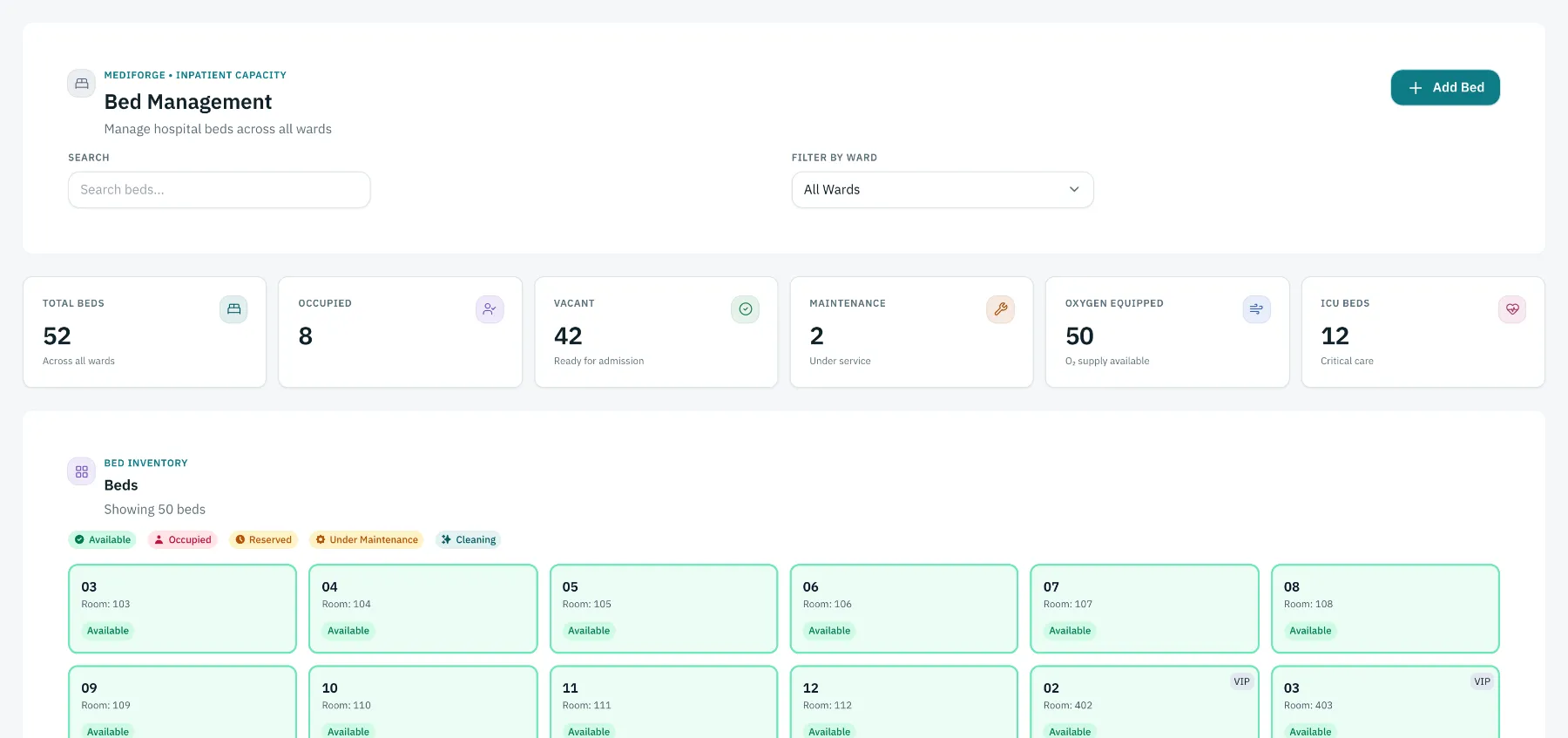
Bed boards and nursing rounds.

Live ward-wise bed status. Auto-refreshes every 30s.

Capacity at a glance, then every bed by room and state.

Explore
Bed board — capacity at a glance, then every bed by room and state.
Platform · Multispecialty

Operation theatre.

IPD, OT lists, discharge summaries — nursing home to teaching hospital.

Moving up a size is a licence change rather than a migration.

Explore
Platform · Diagnostics

Lab, radiology and the blood bank.

View and manage laboratory test reports with critical value highlighting.

Referring doctors get a portal with payout, TDS and GST computed in-system.

Explore
Platform · Emergency

Triage and ambulance dispatch.

Get notified of medical urgencies across departments.

A code-enforced floor stops the AI from ever downgrading urgency.

Explore
Platform · OPD & appointments

Token queues and doctor schedules.

No re-registration, no second form — the token is already waiting when the patient walks in.

Queue Concierge reminds and offers to rebook — never in quiet hours, always on a DLT-registered template.

Explore
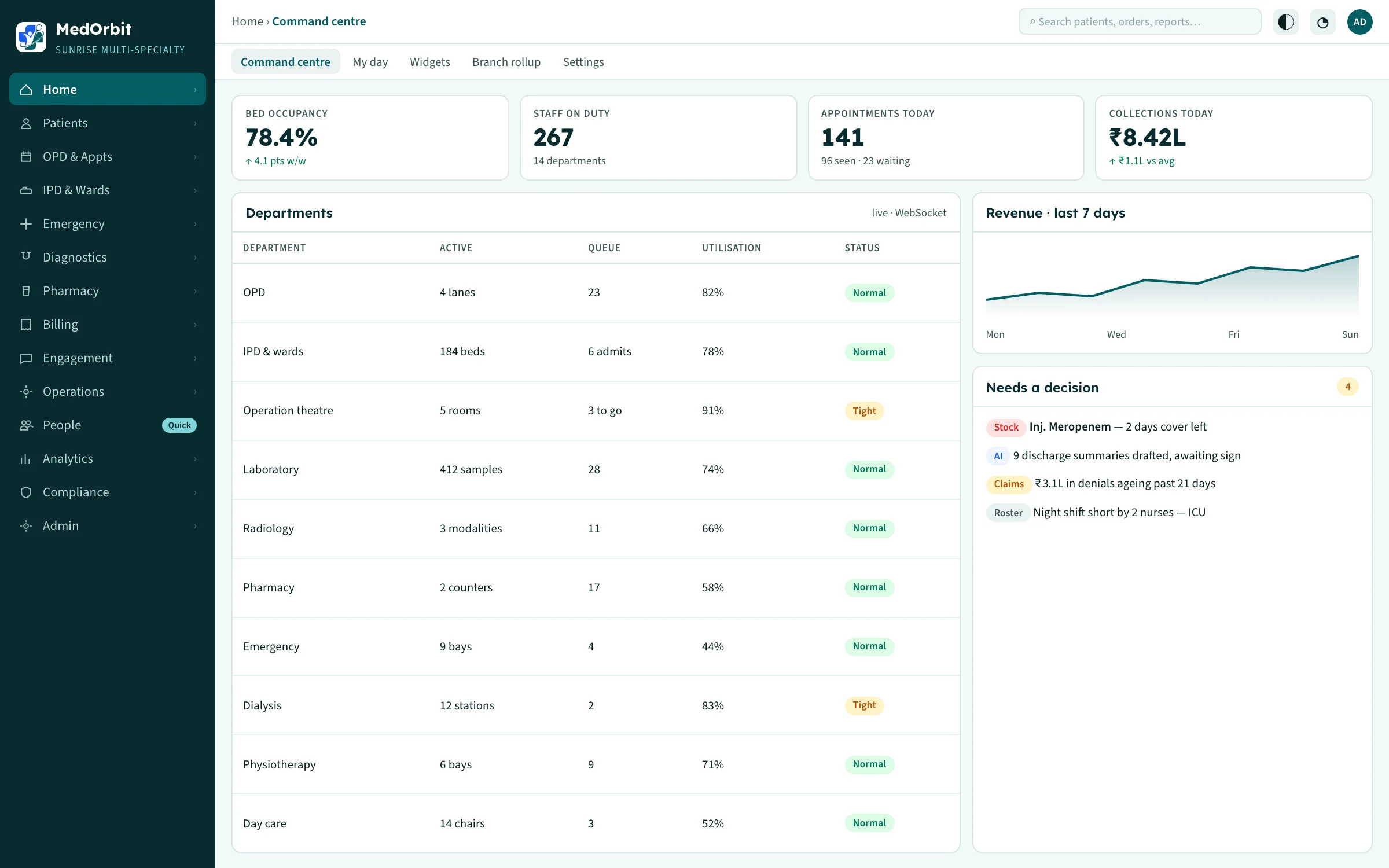
Facility dashboard — every department, one data model.
AI-native HMS · 24 facility types · 11 AI agents

Autopilot your hospital or your clinic.

Features more than you’ll ever need. From billing to patient registration to OPD in one go — every AI action PHI-redacted, audit-logged and approved by your staff.

ABDM-readyDPDP-readyNHCX-readyData in India · ap-south-1

Aftercare · day 2 call · English & Hindi LIVE · 18:05

Agent

“How is the wound site today — any fever or swelling?”

Patient

“A little sore. No fever.”

Agent

“Are you taking the antibiotic twice a day?”

Patient

“Yes, morning and night.”

Agent

“On a scale of one to ten, how bad is the pain right now?”

Patient

“About three. It was six on Monday.”

Agent

“Are you able to walk on your own?”

Patient

“Yes, slowly.”

Agent

“Noted. Shall I book your day 7 check?”

Patient

“Yes, please.”

Structured outcome written to the chart — a nurse handles red flags

Pain score3/10
FeverNone
Wound siteClean
AdherenceYes
Recorded · no red flags · day 7 call queued

Calls and records outcomes. A nurse handles red flags — the agent never advises.

Explore
Isolation

Every hospital’s data lives behind its own wall — and the database holds the key.

Your records are yours alone. A request that does not carry your hospital’s identity gets nothing back — not a shorter list, nothing. Another hospital cannot see your patients even by mistake, because the wall is enforced by the database itself, not by application code remembering to filter.

Only three ways through the wall

  • 1Your own hospital. Staff signed in to Sunrise see Sunrise’s records — every query, every screen, every report.
  • 2An audited break-glass. An emergency override that is switched on deliberately, written to a tamper-evident log, and reviewed.
  • 3The patient’s consent. A time-limited, patient-granted share of one record with another hospital — enforced by the database, revoked automatically when it expires.

Enforced in

Postgres itself. The application signs in as a non-owner role, so a bug in the code cannot switch the wall off.

Written to

A tamper-evident audit trail. A hospital asking for another hospital’s records is recorded — the refusal, not just the read.

Lives in

AWS Mumbai (ap-south-1). Patient records, documents and backups stay in that region — in India.

Everything else — a missing identity, a wrong identity, a bug in the application — gets nothing back. The database does not know how to answer any other way.

Eleven agents · eleven job descriptions

AI staff with a published scope of practice.

Each agent ships with the limit it never crosses, enforced in code rather than promised in a policy.

Front-Desk Voice Agent

Your 24×7 receptionist

Answers every call in your hospital’s name, resolves FAQs, and books appointments straight into your schedule.

Scope of practice

Books and reschedules. Never diagnoses.

Booking tools are cryptographically signed; every call is logged.

Agent 01 of 11

Aftercare Voice Agent

The follow-up caller

Calls every discharged patient on day 2 and day 7, checks recovery, and records structured outcomes.

Scope of practice

Calls and records outcomes. A nurse handles red flags.

Deterioration escalates to your staff — the agent never advises.

Agent 02 of 11

AI Scribe

The note-taker

Turns a recorded consultation into a structured clinical note, ready for the doctor to edit.

Scope of practice

Drafts the note. Never signs it.

Nothing enters the chart without a clinician’s signature.

Agent 03 of 11

Pre-Consult Brief

The chart prepper

Builds a Patient-360 brief — visits, labs, meds, allergies, vitals trend — before the doctor walks in.

Scope of practice

Reads the record. Never writes to it.

Reads the record; never writes to it.

Agent 04 of 11

Consult Summary + Draft-Rx

The documentation assistant

Drafts doctor and patient summaries plus a draft prescription, checked against drug interactions and telemedicine schedules.

Scope of practice

Drafts the prescription. A doctor signs it.

Prescriptions stay drafts until the doctor approves.

Agent 05 of 11

Result Explainer

The patient translator

Explains lab and imaging results in plain language in the patient portal, the moment they release.

Scope of practice

Explains the result. Never changes the numbers.

Guarded output; clinical questions route to your team.

Agent 06 of 11

Referral Triage Router

The referral desk

Reads inbound referrals, drafts urgency and specialty, and chases missing information before the patient travels.

Scope of practice

Triages the referral. Never downgrades urgency.

A code-enforced floor stops the AI from ever downgrading urgency.

Agent 07 of 11

Denial Guard

The claims fighter

Classifies why a claim was denied and drafts the appeal, within value and review thresholds you set.

Scope of practice

Drafts the appeal. A biller files it.

A biller approves every appeal before it leaves.

Agent 08 of 11

Queue Concierge

The waiting-room host

Predicts wait times and proactively updates waiting patients on WhatsApp, rescuing slots before they walk.

Scope of practice

Reminds and offers to rebook. Never messages in quiet hours.

Quiet hours respected; templated messages, AI-read replies.

Agent 09 of 11

Med Reconciliation Sentinel

The safety check

Cross-checks medications against RxNorm and openFDA at every admission and discharge, and flags discrepancies.

Scope of practice

Flags the discrepancy. A pharmacist resolves it.

A pharmacist signs off every reconciliation.

Agent 10 of 11

Sahayak

The language layer

Renders patient communication into Hindi, Marathi, Kannada and more — and falls back to English rather than guess.

Scope of practice

Translates every message. Never touches a dose.

Back-translation QA samples every batch.

Agent 11 of 11

The control line

Every agent pairs a capability with the limit it never crosses. That line is the product — not the model behind it.

data/agents.ts — measured in repo, July 2026.

One clock, one record

A call at 9:42 PM ends as a filed claim. Nothing is re-typed.

These are not integrated modules — they are one system on one clock. Watch a single patient move through it, and note who signs off at each step.

Step 1 · 21:42, after hours

The call is answered before anyone is on shift.

The Front-Desk Voice Agent picks up in your hospital’s name, quotes the real queue, and books straight into the live schedule — in Hindi or English.

Books and reschedules. Never diagnoses. Every booking tool call is cryptographically signed and the call is logged.

Inbound+91 98••• ••2102m 14s
IntentNew appointment · General Medicineresolved
BookedTomorrow 10:20 · Dr. R. Menonsigned
Who signs
The booking tool — cryptographically
Written to
Live schedule + call log
Human in loop
None needed · never diagnoses

The record so far

  1. Patient record
  2. Booking
  3. Token
  4. Clinical note + Rx
  5. Invoice + claim

Step 2 · 10:14, front desk

The token is already waiting when the patient walks in.

No re-registration, no second form. The same patient record carries the ABHA verification, the co-pay and the lane assignment.

Queue Concierge reminds and offers to rebook — never in quiet hours, always on a DLT-registered template.

TokenA-043 · lane 1issued
PatientR. Prakash · UHID 2026-0148verified
Predicted wait12mConcierge notified
Who signs
Front desk — one tap
Written to
OPD queue + patient record
Human in loop
Receptionist confirms identity

The record so far

  1. Patient record
  2. Booking
  3. Token
  4. Clinical note + Rx
  5. Invoice + claim

Step 3 · 10:31, consulting room

The doctor dictates once and walks out with a signed note.

The pre-consult brief is open before the patient sits down. The scribe drafts the note and a prescription; the interaction check runs against RxNorm and openFDA.

Drafts the note. Never signs it. Nothing enters the chart, and no prescription leaves, without a clinician’s signature.

Pre-consult briefvisits · labs · meds · allergiesread-only
Clinical notedrafted by AI Scribeawaiting signature
Draft Rx2 items · 0 interactionsawaiting signature
Who signs
The doctor — always
Written to
Chart + prescription, after signature
Human in loop
Nothing enters unsigned

The record so far

  1. Patient record
  2. Booking
  3. Token
  4. Clinical note + Rx
  5. Invoice + claim

Step 4 · 10:48, billing

The bill builds itself from what actually happened.

Posted charges become a GST e-invoice with an IRN; the cashless claim goes out shaped for NHCX. If it comes back denied, Denial Guard drafts the appeal.

Drafts the appeal. A biller files it. Value and review thresholds are yours to set.

InvoiceGST e-invoice · IRN generatedissued
ClaimNHCX-shaped payload · PM-JAY deskfiled
If deniedappeal drafted by Denial Guarda biller files it
Who signs
A biller — for any appeal
Written to
Ledger + claim, one object
Human in loop
Review thresholds you set

The record so far

  1. Patient record
  2. Booking
  3. Token
  4. Clinical note + Rx
  5. Invoice + claim

Specially made for every doctor specialty.
And for every medical profession.

MedOrbit is designed to suit the diverse needs of doctors and a wide range of medical professions. From OPD care to specialised treatments, MedOrbit is configured to the professional requirements of every specific profession.

Try “I am a cardiologist”, “nurse”, “dental clinic” or “radiologist”. Press Tab to accept the suggestion, Enter to open it.

The India regulatory stack

Built for how India actually regulates healthcare.

CEA registration, licence-expiry countdowns, GST e-invoicing, DLT-compliant SMS and DPDP consent — built in, not bolted on.

Licence renewal radar

Fire NOC20 Aug15d
Pharmacy licence19 Sep45d
Bio-medical waste03 Nov90d
AERB radiation02 Mar210d

The failure mode this removes: a lapse discovered by an inspector. Captured from the running product, 2026-08-05.

Twelve rails

  • ABDM & ABHA-ready — ABHA creation, consent-managed sharing, FHIR R4.
  • NHCX-ready — cashless claim payloads for the Health Claims Exchange.
  • PM-JAY, CGHS & ESIC — scheme desks with their own tariffs and forms.
  • GST e-invoicing — IRN generation, TDS handling, UPI reconciliation.
  • DLT-compliant SMS — registered sender IDs and approved templates.
  • eRaktKosh formats — blood-bank stock and issue in the state format.
  • RTI & DPDP tooling — consent ledger and data-principal requests.
  • AYUSH practice — case sheets, Panchakarma schedules, dispensing.
  • IPHS registers — public-health registers and periodic returns.
  • Hindi & regional messaging — Sahayak renders every patient message.
  • India data residency — everything stays in AWS ap-south-1 (Mumbai).
  • UHI-ready — discovery and booking over the Unified Health Interface.

“-ready” never means live — ABDM, NHCX and UHI await National Health Authority certification.

Interoperability · India-first, standards-global

FHIR R4HL7 v2DICOMLOINCICD-10 / 11RxNormopenFDANAMASTEABDMNHCXGSTDLTUPIUHI

HL7 v2 and FHIR R4 interfaces sit on the same platform as the ABDM and NHCX rails. Standards wordmarks only — no vendor logos.

Choose your plan

Priced per facility, per month. A solo clinic doesn’t pay for a government network. An edition is a starting shape, not a ceiling — AI usage is metered separately, under a daily spend cap you set.

CLINIC_LITE

Solo clinic

  • Appointments & prescriptions
  • Billing & patient portal
  • Front-desk voice agent

Solo-doctor, polyclinic, dental, AYUSH, physio — 8 facility types.

DIAGNOSTICS

Laboratory

  • One worklist for lab & radiology
  • Referring-doctor portal, payout & TDS
  • Westgard QC, PC-PNDT, AERB

Pathology lab, imaging centre, diagnostic centre.

ENTERPRISE

Hospital chains

  • Per-branch registers, roster and rate card
  • One group rollup across branches
  • Isolation enforced per branch

Chains, blood banks, home-health, e-pharmacy, tertiary.

PUBLIC_GOVT

Govt hospitals

  • PHC / CHC / district hospital shapes
  • IPHS registers & periodic returns
  • Multi-site rollup for a district

Government PHC, CHC, district hospital.

Included in every edition

  • 11AI agents availableMetered separately, under a daily spend cap you set per facility.
  • 4India rails on by defaultABDM-ready · DPDP-ready · NHCX-ready · GST e-invoicing.
  • 189Tables under row-level securityTenant isolation enforced in Postgres, not in the ORM.
  • 1Region — AWS ap-south-1Records, documents and backups stay in Mumbai. Role-based training at go-live.

Figures published per edition once each one’s inclusions are verified — ask for a written quote for your facility type.

Objections first

A single-doctor clinic can run MedOrbit on its own. It ships as five editions across 24 facility types, and the smallest — CLINIC_LITE — is appointments, prescriptions, billing and a patient portal, with wards, operation theatre and bed management simply not switched on, so nobody navigates around empty screens. The same platform scales up through nursing homes and multi-specialty hospitals to hospital chains. Moving up a size is a licence change rather than a migration: the patient record, the ledger and the audit trail are the same objects at every size, which is why a clinic that grows into a hospital does not have to change software.

It runs a diagnostic centre on its own. DIAGNOSTICS is one of five sellable editions and DIAGNOSTIC_CENTER is a first-class facility type, so a pathology lab, an imaging centre or a combined lab-and-imaging centre is the whole customer rather than a department of an imagined hospital. Lab accessions and radiology studies share one worklist and one front desk; collection centres and home collection settle into the same ledger as the main lab; referring doctors get a portal with payout, TDS and GST computed in-system; and the statutory side — Westgard multi-rule QC, critical-value read-back, the PC-PNDT Form F register and AERB radiation licence tracking — is built in. MedOrbit runs those registers and rules; the accreditation itself remains yours.

MedOrbit is an AI-native hospital management system built for 24 types of Indian healthcare facility, from a solo clinic to a government hospital. ABDM-ready means ABHA creation, consent-managed record sharing and FHIR R4 exchange are built and waiting on National Health Authority certification — not live today, and any vendor who claims otherwise should be asked for the certificate. Compare us on the rails you actually run on: ABDM, NHCX claims, PM-JAY and CGHS desks, GST e-invoicing, DLT-compliant messaging and data residency in India.

Yes. The front-desk voice agent answers your hospital line around the clock, quotes queue status, and books, reschedules or cancels appointments straight into your schedule — in Hindi or English. Every booking action is cryptographically signed and every call is logged, so your staff opens the morning worklist knowing exactly what was said. The agent never diagnoses, and telephony is armed per facility, so you decide when it starts taking calls.

Yes. MedOrbit runs in AWS ap-south-1 (Mumbai), and patient records, documents and backups stay in that region. Lab report PDFs are digitally signed and prescriptions carry a verifiable QR code, so a document can be checked outside the system. Access to patient data is logged per user.

Consent is recorded in a ledger rather than assumed, and data-principal requests — access, correction, erasure — are handled inside the system with an audit trail. Patient identifiers are redacted before any AI model call, and your data is not used to train models. Breach registers and grievance routing are part of the same tooling, so a request never depends on someone remembering to file it.

MedOrbit is priced per facility per month across five editions, so a solo clinic doesn’t pay for a government network. Published figures go on the pricing page once each edition’s inclusions are verified; until then, ask us for a written quote for your facility type and we will show you what drives it. AI agent usage is metered separately, under a daily spend cap you set per facility.

Yes. Guided imports cover patients, staff, doctors, tariffs and stock, and HL7 v2, FHIR R4 and CSV pipelines bring historical records across. Plan the sequence with us — masters first, then balances, then history — so billing stays reconcilable from day one.

Training is role-based: receptionists, nurses, doctors, pharmacists, lab staff and billing each get a walkthrough of the screens they actually use. Go-live is supported by the team that builds the platform, and every facility has a named contact. AI agents come last and one at a time — you switch one on, watch it work in dry-run, then let it act.

Access is role-based and tenant-scoped, with row-level security on the most sensitive PHI tables and app-layer tenant scoping throughout. Patient identifiers are redacted before any AI model call, every AI action is written to a tamper-evident audit trail, and each agent has a kill switch. Spending on AI is capped per facility per day, and clinical documents leave the system signed.

Compare with other HMS platforms

CapabilityMedOrbitMocDocCaresoft HMSoeHealthOnecareHMSCliniqwise
Patient registration
Appointment scheduling
Conversation note taker———
WhatsApp reminder——
Patient follow-up—————
Front-desk AI caller—————
Result explainer—————

Competitor columns reflect what each vendor lists on its own public website, checked August 2026. A dash means we could not find the capability listed there — not that it does not exist. If we have missed something, write to hello@medorbit.ai and we will correct it. Longer write-ups: MedOrbit vs MocDoc, vs KareXpert, vs Eka Care.

Made in India. To assist patients, doctors, nurses, admins, pharmacists, lab teams, billing and reception.

Healthcare is advancing rapidly. Take control and turn your daily work into a series of automations that increase efficiency manifold. MedOrbit is developed to assist all medical professions, and all doctors from oncology to cardiology, to create a seamless working experience. Request a live demo today to see it in action.